


For nearly two decades, PrairieCare has been a leader in mental healthcare in Minnesota. Families know us as a trusted place where their loved ones are met with compassion and understanding. Professionals consider us an organization that sets the standard for excellence in mental health through a comprehensive continuum of care, including our inpatient hospital. And individuals reflect on us as a place of hope, one of the most vital aspects of recovery.
PrairieCare is a trusted name not only because of the services we provide, but also because of the people who deliver them. Many of our team members have dedicated years of their diverse careers and expertise to growing our organization and providing specialized care to people of all ages when they need it most. Their experiences show why PrairieCare is more than a mental health provider; it’s a place of hope, growth, and lasting change that evolves with our community.
Hear from some of our long-term team members who have played an integral role in growing our care and setting an example for adapting and responding to community needs.
What You’ll Learn
- What makes PrairieCare one of Minnesota’s most trusted names in mental healthcare?
- How has PrairieCare reimagined inpatient psychiatric care to better serve patients and families?
- In what ways does our continuum of care adapt to the evolving needs of individuals across all life stages?
- How do long-time PrairieCare team members shape the organization’s culture and approach to healing?
- What mental health programs does PrairieCare provide?
Quick Read
For nearly two decades, PrairieCare has redefined what it means to deliver mental healthcare in Minnesota. Families know us for our compassion, professionals trust us for the high quality of our care, and individuals turn to us for hope and healing. At every level, PrairieCare is setting the standard for mental health services across Minnesota.
What makes PrairieCare unique is not only the services we provide, but the people behind them. Many of our team members have dedicated years of their careers to advancing our mission, bringing diverse expertise to serve patients of all ages. Their commitment reflects why PrairieCare is more than a provider—it is a place of growth, healing, and lasting change that adapts to the evolving needs of our community.
That commitment shines through in every level of care we offer. From outpatient therapy to intensive programs and hospital-based treatment, PrairieCare helps patients navigate every stage of their journey. With a focus on long-term healing, collaboration, and compassion, we continue to be one of Minnesota’s most trusted names in mental healthcare.
A Place with Purpose and Vision
When asked what sets PrairieCare apart, CEO Todd Archbold, LSW, MBA, doesn’t hesitate. “PrairieCare truly is a place with purpose,” he says. “Our incredible people and teams are our advantage—they power our mission through compassion and grit.”
That sense of purpose has guided PrairieCare since its earliest days. When PrairieCare opened our first specialty mental health hospital for young people in 2011, and expanded to our current location in 2015, the goal was to increase access to psychiatric are, and also to transform how it’s delivered.
“We exploded the paradigm of what a mental health hospital looks like,” Archbold reflects. “We created beautiful, state-of-the-art facilities powered by multidisciplinary teams focused on the whole person. Since that time, numerous other health systems have renovated their mental health units, invested in partial hospitalization, and designed teams to match our standards. We are proud to be leaders in this space.”
This leadership is focused on creating long-term healing, beyond addressing the symptoms a patient is experiencing during their initial intake. The PrairieCare team aims for complete healing, not just moving past the crisis point. Although mental health disorders don’t disappear, our goal is to help people live fulfilling lives through comprehensive recovery.
For patients and their families, this vision translates to care that supports them moment to moment while also looking toward the future. Through a treatment-to-remission philosophy, our team can adapt care as needed to ensure long-term healing is possible. This concept raises the bar in psychiatric care, shifting from managing crises to providing ongoing support that helps people reach their goals, both clinically and personally.
Care and Support That Evolves with Patients
Mental health journeys are rarely linear. Needs change over time, based on life stages, new stressors, and/or available support systems. Given the complexity of mental health diagnoses and ever-changing life circumstances, patients often require different levels of support along the way. That’s where PrairieCare’s continuum of care, services, and specialty supports stand out.
From traditional weekly therapy to inpatient hospitalization for psychiatric stabilization, to support for new parents in our perinatal IOP, we can treat a wide range of unique needs, and patients can move seamlessly to a different level of care as appropriate. “We strive to meet patients where they are at, and to provide care at a level that mirrors their needs and offers the best chance for meaningful and sustained improvements,” says Chad Puffer, DO, Medical Director of Outpatient Services.
Because the challenges our patients and families face are constantly evolving, the team continually adapts and will never be satisfied with the status quo. One example of Dr. Puffer’s role as a clinician and Medical Director of Outpatient Services is leading efforts to improve electronic records with thoughtfully tested AI. This technology helps reduce errors and provide timely information, allowing clinicians to spend more time with patients rather than on computers.

This same sentiment extends to our highest level of care—our inpatient hospital. Katie Johnson, MA, LMFT, who started with PrairieCare as an inpatient therapist nearly a decade ago, and is now the Inpatient Services Division Director and Clinical Operations Director, explains: “For patients struggling with significant concerns, receiving care within a system that can provide both outpatient and inpatient care is invaluable. When PrairieCare doesn’t offer a specific service, we connect families to resources outside our system. When people place their trust in us, we do everything we can to find them the support they need.”
This flexibility—both within PrairieCare and through our partnerships—ensures that individuals and families never feel alone in navigating where to start or what comes next. From the first call, patients and referring professionals are met with experts who point them in the right direction. PrairieCare has also been at the center of multiple projects that innovate solutions to systemic challenges within mental healthcare.

“We developed statewide access to free consultations through the Psychiatric Assistance Line, and built a Mental Health Collaboration Hub to help kids boarding in hospitals get access to care. These initiatives have helped thousands of individuals,” said Todd.
These resources would not exist without powerful insights from leadership who are always listening and responding to the needs and stories of our patients. PrairieCare’s influence in the mental health space extends beyond our organization, helping to create change not only for the patients we care for, but also in the day-to-day work of hardworking professionals across Minnesota and the country. Collaborations are the key to change, improvement, and the ability to quickly respond to what’s needed in the community.
Healing Rooted in Relationships
At PrairieCare, connection and strong relationships are at the heart of our healing approach. It’s not just about what treatment is provided but how it’s delivered. In fact, love is one of our company’s core values: We care for patients with unconditional support so that they can learn to love themselves.
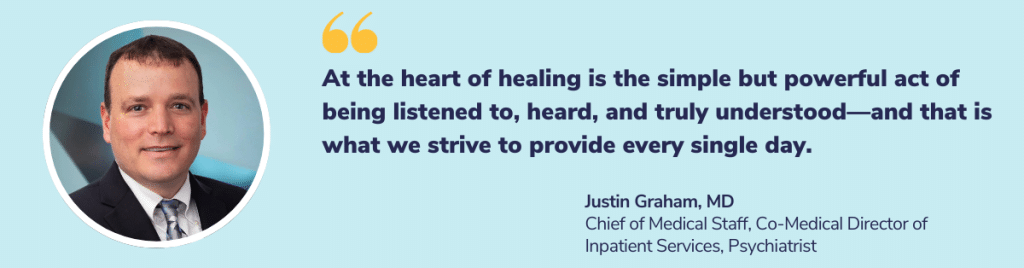
For Dr. Graham, progress is often measured by the hope and strength that patients and families find through being supported with dignity.
Our staff genuinely cares about the people we work with, and this feeling extends to the standards of daily support we provide. Mallory Jacobsen, MSW, LICSW, the Director of Social Work, highlights how PrairieCare’s philosophy of care reinforces this relational approach. “We practice Collaborative Problem Solving, an evidence-based approach focused on understanding and building skills. Our compassionate mindset makes a lasting impact on those we serve, as well as on each other.”
For clinicians like Dr. Puffer, relationships are also a personal motivator for the work. “I feel honored when people share their successes and struggles with me,” he shares. “I strive to practice in a way that incorporates the idea that connecting with our world through relationships, activities, and self-exploration supports growth and development at any age.”
Where do our compassionate and skilled multidisciplinary teams find the motivation to consistently strive for excellence each day? Like any other part of healthcare, it can be challenging and intense work, but with a strong, passionate network of individuals, it’s much easier.
All who come through our doors encounter a culture of compassion where they or their loved one will be understood and supported. The collaborative environment among our team members supports us to offer patients the hope they need during some of their darkest times.
Expanding Access and Supporting Community
Since providing individualized mental healthcare is our primary mission, we’re always exploring ways to adjust each aspect of our care—partnerships, facilities, treatment, and admissions—in response to the real-life experiences of Minnesotans.
“Our ability to evolve sets us apart,” says Mallory. “For example, we have a strong partnership with the Red Lake Nation to support Native American youth, during care and as they transition back to community-based services. Reducing healthcare disparities opens the door to more equitable outcomes for people of all backgrounds, and we are continually working to remove barriers.”
Katie highlights the hospital’s responsiveness in understanding the needs of patients with acute mental health symptoms. “As a large hospital, we pivot quickly to adapt to the needs of the patients who are coming to us. We’ve adapted our inclusion and exclusion criteria, improved protocols for those with co-occurring substance use, and created a process for patients to admit directly from the community, avoiding the ER in some cases.”
For patients, these efforts mean that care is easier to access and more accurately tailored to real-life circumstances.

Experienced Teams, Lasting Impact
Our long-time employees embody PrairieCare’s mission every day and carry it out in the treatment we provide. Their dedication and loyalty to our programs help us adapt and grow, guided by years of evidence. The diverse clinical backgrounds of our staff also inform decision-making across nearly every aspect of what we do.
PrairieCare’s multidisciplinary treatment teams have expertise in caring for individuals with a wide range of psychiatric needs, and they do so collaboratively within our continuum of care. Our teams work together and take on the complexities of healthcare so that our patients and their loved ones can focus on being actively engaged in their treatment, in partnership with trusted experts, within safe and respectful therapeutic spaces.
“We focus exclusively on mental health, and it shows the priority this organization places on care,” says Clinical Nurse Educator Rachel Jefferies, RN. For example, our inpatient hospital is the first in Minnesota to receive the ANCC Care Pathways designation, a nursing honor that recognizes a healthy work environment. This designation demonstrates the support our team feels, which in turn enhances the well-being of our patients.
In the hospital setting, our expertise is reflected in our 2023 expansion, inspired by the insights of patient and staff members. “There has been a conscious effort to create a hospital that feels welcoming and healing,” said Katie.

A Trusted Mental Health Provider for People Across Minnesota
From its earliest days to today, PrairieCare has been defined by its people—their purpose, compassion, and relentless commitment to helping others heal. By offering a full continuum of care, adapting to community needs, and fostering a supportive environment, PrairieCare has established itself as one of Minnesota’s most trusted names in mental healthcare.
As CEO Todd Archbold reminds us: “The best views come after the hardest climbs. When we hear from our patients about how their experience at PrairieCare has changed their lives, it is all worth it—and that inspiration becomes fuel for the next challenge.”
Access Trusted Mental Health Care Today
We offer comprehensive services in the Twin Cities, Mankato, and Rochester for people of all ages. No matter where someone is in their journey, we’re here to help. Our care offerings include the following:
- Inpatient Psychiatric Hospitalization: Short-term, 24/7 hospital-based care during a severe depressive episode or crisis for children, teens, and young adults. Ensures safety, offers immediate stabilization, and prepares patients for the next step of treatment.
- Residential Treatment: Longer-term, 24/7 care in a non-hospital setting for adolescents. Provides intensive daily therapy in a structured environment to address persistent depression.
- Partial Hospitalization Program (PHP): A full-day program without an overnight stay. Provides intensive therapy, structured routines, and medication management. Supports mood stabilization and helps prevent inpatient hospitalization.
- Intensive Outpatient Program (IOP): A partial-day program offering group therapy, coping skills training, and peer connection while allowing patients to live at home and continue daily routines. Includes a perinatal IOP track.
- Clinic services: Provides ongoing support through sessions with a therapist. Focuses on coping strategies, identifying thought patterns, and building long-term tools to manage depression. We also have Transcranial Magnetic Stimulation (TMS) for qualifying patients with treatment-resistant depression.
If you’re unsure about the proper care for you, a loved one, or a person you care for, our experts can help find the right path forward. Talk with our team today at 952-826-8475.