


Attachment-Based Family Therapy is an evidence-based approach used for treating depression and preventing suicide in adolescents. This therapeutic modality utilizes a structured methodology that revitalizes empathy and authentic connection within the parent-child relationship.
“Parenting is built on two pillars—love and empathy, and structure and protection,” says Guy Diamond, PhD, co-creator of Attachment-Based Family Therapy (ABFT). “Empathy is one of a parent’s most important tools for facilitating a child’s development. It allows them to understand the inner life of their child, to perceive what they’re thinking and feeling and help them become aware of their emotional landscape.”
A key element in this approach to treatment, ABFT aims to repair damage in the family system, so teens feel safe turning to their parents for support. Hence, teen mental health improves, and the risk of teen suicide ideation and behavior goes down. Consequently, ABFT is a powerful approach to supporting adolescent well-being.
Learn more about ABFT and how it can be a powerful therapy approach for teenagers with mental health challenges.
The Link Between Family Attachments and Mental Health
Genetics and biology influence adolescent mental health. However, family relationships and attachments tremendously impact a teenager’s well-being.
“The family is the secure base for child development,” Dr. Diamond says. “It is the schoolroom of life, where kids learn about themselves, learn how to trust people, and learn how to manage their emotions better.”
That’s why, according to ABFT philosophy, the following family circumstances have a significantly negative impact on teen mental health:
- Family conflict
- Detachment
- Harsh criticism
- Abandonment
- Neglect
- Abuse
- Other family traumas.
In addition, the impact of these issues within the family is compounded when parents fail to comfort and support teens. Parents can sometimes fail to help teens process these disturbing experiences. In return, the result may be relational trauma, teen PTSD, teen depression, and/or other adolescent mental health conditions. A teen mental health problem then further strains the parent’s resources.
“It’s hard enough to raise an adolescent, let alone a depressed adolescent,” Dr. Diamond notes. “When parents get burnt out, it’s harder for them to access empathy as one of their parenting tools.”
However, when adolescents perceive their parents as caring, protective, and trusting, the family becomes a strong foundation. These family bonds will eventually help teens weather life challenges. That’s why family therapy for adolescents with mental health challenges is an essential part of a teen treatment plan.
The Development of Attachment-Based Family Therapy
Attachment-Based Family Therapy is the first adolescent family therapy designed to target family processes associated with teen depression and suicide. It grew out of various mental health modalities and philosophies. Most importantly, John Bowlby’s attachment theory inspired and influenced ABFT. This theory posits that humans have an inherent biological desire for meaningful relationships. Consequently, interpersonal relationships within the family system profoundly affect teen mental health. Therefore, Attachment-Based Family Therapy is a trust-based and emotion-focused psychotherapy model that focuses on improving family relationships.
Furthermore, the following modalities also influenced the ABFT model:
- Structural Family Therapy
- Multidimensional Family Therapy
- Emotionally Focused Therapy.
How Attachment-Based Family Therapy Repairs Relationships
The structure of ABFT includes five distinct treatment phases, sometimes referred to as “treatment tasks.” Each phase has clear goals and strategies, providing a clear road map to healing and recovery. Each step of the process repairs ruptures in the attachment relationship.
“A challenge with other family therapy approaches is that when parents admit their child to treatment, parents are often focused on their child’s behavior, resulting in parental anxiety, anger, and resentment,” says Dr. Nosal. “ABFT provides the opportunity for the family therapist to work individually with parents to identify their own childhood attachment ruptures. This process moves parents away from being focused on behavior to being emotionally focused, resulting in greater understanding of their child’s experience and feelings.”
In addition, Dr. Diamond says, the ABFT process recognizes parents for their accomplishments, reminds them of our strengths, and revives their innate caregiving instinct so they can be the kind of parent they want or need to be. “We help parents establish warmth and structure, empathy and expectation. Then kids have the freedom to access their own pain and confusion and figure out who they are, with the support of a secure base.”

The Five Treatment Phases of Attachment-Based Family Therapy
- Reframing the therapy to focus on interpersonal development: The ABFT therapist shifts the focus away from symptoms and toward improving the parent-child relationship. The first goal of treatment is to discover what damages the trust in the relationship.
- Building an alliance with the adolescent: In individual sessions, the therapist learns about the teen’s strengths and interests. Moreover, the therapist helps the teenager understand and articulate the ruptures that occurred in their relationship with their parents.
- Forging an alliance with the parents: The therapist’s next task is to build an alliance with the parents in sessions without the adolescent. By offering empathy and support, the therapist creates trust and connection and helps parents access their own empathic instincts. The therapist may work with the parents to explore their own attachment issues from childhood.
- Facilitating conversations to resolve attachment ruptures: This is the central mechanism of ABFT. When adolescents and parents are ready, the therapist brings them together to discuss the teen’s concerns. The therapist guides the adolescent to express their grievances—in a mature, calm way. In addition, the therapist encourages the parents to express empathy and understanding. This exchange lays the foundation for a more securely attached relationship between parent and child. When teens feel heard, they are more able to understand and empathize with what their parents are feeling.
- Promoting autonomy and competency in the adolescent: The last phase of ABFT is helping teens find appropriate autonomy and independence. Therapists encourage teens to socialize and pursue activities outside the home, thereby giving them a sense of empowerment and confidence. Moreover, therapists guide parents to support their children but also allow them to make their own choices and take responsibility for their own behaviors.
What Is a Secure Attachment?
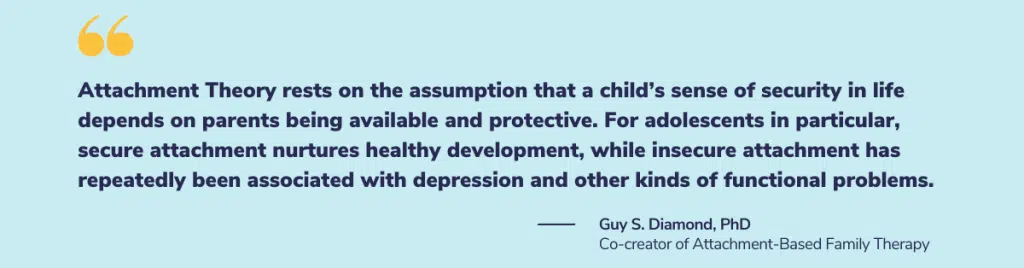
According to attachment theory, a secure attachment develops when parents are sensitive to a child’s needs. As a result, secure attachment supports a child’s development. This leads to good emotional regulation skills, increasing adolescents’ feelings of self-worth.
In the fourth step of the ABFT process, therapists foster attachment therapy experiences. During these sessions, adolescents receive love and support from their parents. These experiences help reinforce the primal attachment between parent and child. And strengthen a solid foundation that protects the teen against depression and suicide.
Research on Attachment-Based Family Therapy for Teen Depression
In a prominent study on the efficacy of ABFT for adolescent depression, teens were randomly assigned to 12 weeks of ABFT or a six-week control group. The control group did not receive ABFT.
Following treatment, 81 percent of the patients treated with ABFT no longer met the criteria for major depressive disorder (MDD). Moreover, 87 percent did not meet the MDD criteria six months after treatment ended.
Researchers found that ABFT had the following positive results for adolescents:
- Significant decreases in rates of depression diagnosis
- Reduced severity of depression and anxiety symptoms
- Decreases in feelings of hopelessness
- Lower incidence of suicidal ideation
- Increased attachment to their mothers
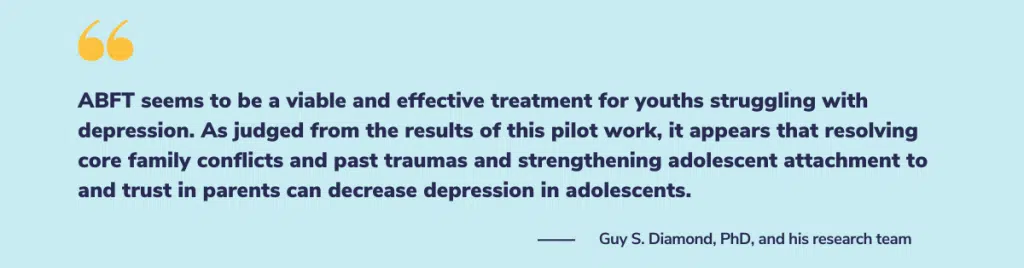
As a result, healing root issues such as relational trauma and depression decreases the risk of co-occurring problems, such as substance use and eating disorders.
Attachment-Based Family Therapy and Suicidal Ideation Study
Attachment-Based Family Therapy is also effective in reducing suicidal thoughts in teens. In another study, Dr. Diamond and his team worked with suicidal adolescents between the ages of 12 and 17.
In the study, youth treated with Attachment-Based Family Therapy demonstrated significantly greater and more rapid reductions in suicidal ideation during the treatment. These improvements held steady six months after treatment and were four times as likely to be successful for these teenagers.
It showed that ABFT provided more rapid relief from depressive symptoms than conventional care. As the researchers noted, this type of family intervention is an important advantage when youth are at risk for suicide.

Attachment-Based Family Therapy for Anxiety
ABFT is also used for working with adolescents with anxiety disorders. This approach combines ABFT with Cognitive Behavioral Therapy. The basic structure of the five tasks is modified for adolescents with anxiety. The four main processes explore parental beliefs about anxiety, family modeling of anxious behavior, encouragement of avoidance, and parents’ psychological control related to family conflict.
In families with anxious adolescents, parents encourage teens to avoid behaviors that produce anxiety. Moreover, they attempt to control their teenager’s experiences to prevent symptoms of anxiety. As a result, teens become overly dependent on their parents.
Attachment-Based Family Therapy for teen anxiety focuses on identifying parents’ worries and fears and how these might affect their children. Moreover, therapists help teens recognize how family dynamics affect their anxiety and their ability to be independent. Then, parents and teens come together to discuss how to move forward with greater harmony.
ABFT as an Adaptable Approach
Moreover, ABFT is adaptable to meet varying lengths of stay and levels of care. Thus, ABFT can be used during a 30-day stay in residential treatment or for longer stays. It can also be adapted to support teens and families during the transition from residential treatment to a Partial Hospital Program (PHP) or Intensive Outpatient Program (IOP).
Attachment-Based Family Therapy is a scientifically validated and effective clinical modality. It is proven to heal the family system. Consequently, as a result of stronger family relationships, teens can heal from mental health disorders.
Attachment-Based Family Therapy in Minneapolis
If you are in the Twin Cities and looking for a family-based therapy for teens, our Center for Families (CFF) location in Minneapolis could be the perfect fit. Our CFF outpatient programs focus on sustainable healing for teens between the ages of 13 and 18, through evidence-based clinical therapy, support groups, and psychoeducation—with family involved every step of the way. We offer partial-day and full-day levels of care to meet patients where they are in their mental heal journey.
If you think your teen can benefit from mental health support, we are here to help. Contact us at 952-826-8475 any time and our team of experts will find the right fit for your child. You can also fill out our request form, and within one business day we will contact you to complete a no-cost mental health screening.

About PrairieCare
At PrairieCare, we provide hope and healing to individuals of all ages through comprehensive mental health services. PrairieCare is one of the nation’s leading providers of premier psychiatric services to the Twin Cities metro area, Rochester, and Mankato. Our programs and services span the full continuum of care, with the understanding that each patient has unique experiences, life stages, and needs.
Sources:
- American Psychological Association
- J Am Acad Child Adolesc Psychiatry. 2002 Oct;41(10):1190–6.
- J Am Acad Child Adolesc Psychiatry. 2010 Feb;49(2):122-31.