


The race to the White House has begun, and with that comes the anxiety-invoking conversations. Three-quarters of Americans feel anxious about the election, and 40 percent say they’ve already “checked out” due to the influx of political-based media coverage. But political conversations are almost unavoidable, especially with family and friends who are close to you.
Whether at your parent’s house for dinner or talking with a friend on the phone, election-based conversations can arise anytime. Fueled by sensitive subjects such as immigration, healthcare, and the economy, they can become uncomfortable quickly.
In this article, we guide you on approaching conversations that help you feel empowered and safe during a time that can feel uncertain—without totally cutting off those around you. Also, you can download our Mental Health Roadmap for Navigating Election Season to get more helpful tips on staying balanced, managing your media intake, and supporting teens!
Quick links:
- The Signs to Follow in Election-Based Interactions
- How to Set Boundaries with Those Around You
- Get a No-Cost Mental Health Screening Today
How Americans Feel About Talking Politics
If there’s one thing everyone can agree on, it is that talking to people who disagree with their views is stressful. Nearly 60 percent of Americans, including Democrats, Republicans, and Independents, say they find these conversations stressful, according to a recent Pew Research Center study. And the American Psychiatric Association found that 73% of adults view the US election as the most anxiety-inducing topic, more than current events (70%) or gun violence (69%).
It’s no wonder that almost half (45%) of adults have stopped talking about political and election news based on a negative conversation they have had in the past. However, a recent study shows that discussions between those with differing opinions can be powerful—but negative expectations of the outcome of those conversations hold people back from talking with others who might not agree with them.
Having productive conversations may be one of the best things we can do to overcome election anxiety. They help us find community and make connections and allow us to voice our opinions in thoughtful ways rather than bottling them up until we explode (or implode).
But if you need support from a professional, you can always call us at 952-826-8475 or by requesting a no-cost mental health screening using our form.
The Rules of the Road for Positive Political Talk
This election season, you can think of six pillars of positive political talk to guide productive, not combative, connections with others. We recommend the following:
- Curiosity: Try to learn about someone’s perception outside of your own.
- Connection: Seek common ground, even small things can go a long way.
- Respect: Remember everyone has value and give the same consideration you would want for yourself.
- Openness: Know people have different perspectives and stay open to learning them.
- Support: Be there for others and for yourself.
- Generosity: Inspire yourself to help others even if it’s something simple.

The Signs to Follow in Election-Based Interactions
Here’s how to recognize the “signs” of political talk and maneuver them carefully to avoid a conversational traffic jam and potential mental health crash.
Green Light Go-Aheads
If you’re with someone who you feel comfortable talking about politics, that’s great! These connections can ground us and allow us to express our feelings during a time that can feel so divided.
Use these pointers for a respectful interaction:
- Be an active listener: Make sure you allow them to talk. Part of this includes positive body language that shows you’re interested in them as well as what they have to say.
- Stay curious, not combative: If someone’s opinion differs from yours, engage your curiosity about why that may be, and don’t make assumptions. This can include asking open-ended questions to learn more.
- Emphasize values rather than a party or person: Instead of talking about who you’re voting for, express what’s important to you, like education, healthcare, or economics. Finding common ground on what we care about can show us just how similar we are, rather than creating a bigger divide.
Middle-Ground Go-Tos
Let’s say you’re with a stranger or a family member you don’t want to upset, or you just don’t have the mental capacity to get into an intense discussion. You can always pivot the chat to something less polarizing. Anastasia Ristau, PhD, LP, a psychologist with PrairieCare, says it’s important to remind yourself that you ultimately get to choose what you believe, think, and feel—no matter what anyone else says or believes.
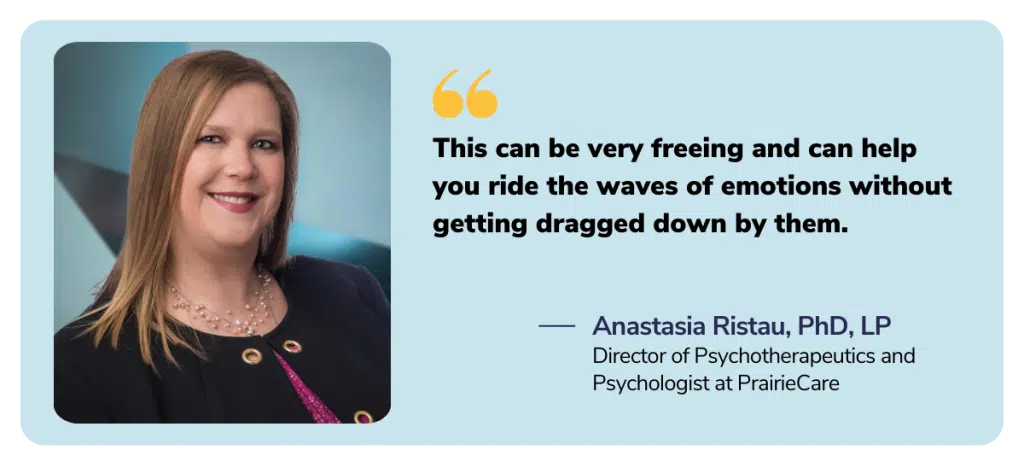
Dr. Ristau shared some ways you can steer the conversation toward safer ground:
- “I respect your right to your viewpoint, but I’m just not in the right mindset to talk about this right now.”
- “I can see you have strong feelings about that! I respect that you have your own perspective.”
- “I can see you have lots of reasons to believe the way you do, just like I have lots of reasons to believe the way that I do.”
Hard-Stop Situations
Context is everything when determining if it’s really the right time to talk politics. Consider what’s happening around and inside you—the environment, the people you’re with, and your current level of well-being.
There are lots of reasons why you might need to stop or avoid a conversation, but we’ve identified the top four:
- In the workplace: Being professional is all about respect, which can be tricky in politics. Avoiding the topic is wiser. Close to half of people in a recent CNBC survey said they would prefer to ban political talk at work.
- If you feel physically or mentally overwhelmed: Protecting your own health and well-being may be enough to deal with already—you don’t need to add extra stress. If you’re feeling fragile, there’s also a higher chance that you’ll have less tolerance for others.
- When you know it won’t go well: If a previous conversation with this person went awry or you know they won’t tolerate other POVs, stick with neutral conversation topics and stay away from politics.
- If you feel targeted or fear for your safety: Unfortunately, certain populations can become targeted in an election and take center stage. You should never feel that you have to fight for a particular group if putting yourself out there puts your safety at risk.
The “White Flag” Method of Ending Conversations
Coined by renowned matchmaker Rachel Greenwald, the white flag approach can be used to signal your final lap of conversation—just like NASCAR does it. No matter how your conversation went, try to bring it back to the person and away from politics. Let them know you are about to leave, ask about something in their life, and actively listen before saying goodbye. That way, you’re making a connection outside of politics.
Here are some examples of how this can sound:
- “I’m just about to head out, but I remember you started a new job. How exciting! How’s that going for you?”
- “Election season sure can be a lot! I have an appointment, but wanted to see how the new semester is going. Do you have a favorite course?”
- “I have to get going, but how is your puppy doing before I head out? The last time I saw pictures she was so little!”
Pivoting conversations away from political topics can be a great way to let a person feel seen and leave on a positive note. If you have a challenging relationship with someone with whom you see on a consistent basis, it may be best to set boundaries.

How to Set Boundaries with Those Around You
Boundaries are a set of rules or expectations that are set between people to avoid harm and even strengthen relationships. Setting boundaries can be extra helpful when you need to interact with a person with challenging points of view that you see constantly, such as a next-door neighbor or coworker.
Identify what is challenging for you.
If you are talking with someone and you start to feel tense or uncomfortable, it’s time to speak with the person. Is there a specific thing that was said or action they took to make you feel this way? Identify what made you have negative emotions and evaluate the priorities you hope to maintain.
Communicate with the person.
Go into the conversation with the person you are hoping to set a boundary with a level head. This is a productive conversation, so make sure it doesn’t escalate. Explain to them what a challenge in the past has been, let them know how it made you feel, and a way to move forward. It can sound like, “Last time we talked, I noticed we both were frustrated with each other’s political views, and I felt uncomfortable. Would it be okay if we avoided this subject? I want to make sure we can still be great (neighbors, coworkers, etc).”
Respect what has been determined.
Although this conversation can be awkward, your well-being is ultimately more important. You must also ensure you respect the other parties’ guidelines. Follow their needs and check in if needed to ensure they still work for both people.
Determining a boundary system can help you keep connections, while respecting yourself and others. Election-season can be tough, so setting guidelines to have healthy interactions can be a great adjustment in your daily life. If interacting with others continues to be a challenge, you can always look into support from a professional.
If Mental Health Challenges Continue After Election Season
If you or someone close to you continues to have anxiety or other mental health challenges past election season, it’s time to get help. PrairieCare provides comprehensive mental health services at various locations in Minnesota for all ages. Our multidisciplinary teams and full continuum of care offer you the care you need to overcome mental health challenges and to thrive.
Get a No-Cost Mental Health Screening Today
Anyone seeking services can call our team anytime at 952-826-8475 to access a no-cost mental health screening and ask any questions you may have about starting therapy. You can also request a screening using our form and within one business day our team will reach out to you to get started. Not sure what a mental health screening includes? Click here to learn more about screenings.
About PrairieCare
At PrairieCare, we provide hope and healing to individuals of all ages through comprehensive mental health services. PrairieCare is one of the nation’s largest providers of premier psychiatric services to the Twin Cities metro area, Rochester, and Mankato. Our programs and services span the full continuum of care, with the understanding that each patient has unique experiences, life stages, and needs. Get started today.