


It’s the happiest time of year again—but how many people really feel that way? The holiday season is full of expectations, especially for parents or caregivers who are already balancing work on top of family get-togethers, winter break for school-age children, financial pressures, and more.
As we enter the winter holiday season, many families spend more time together than usual. Although this can be a wholesome time, it can also be a source of frustration and difficult behavioral patterns for children, young adults, and even for parents. This time together can be an ideal opportunity for the whole family to check in on their mental wellness.
Remember, as a parent or caregiver, you’re not alone, and many people feel the same way about the holidays as you. Our expert helps guide you through the stress of the holidays and offers practical tips on re-envisioning what the holidays are truly about—by putting your mental well-being first.
Give the Gift of Mental Wellness to You and Your Loved Ones
Parenthood is already stressful, and the extra layer of the holidays can make it feel even harder. Just this year, the US Surgeon General issued an advisory on the mental health and well-being of parents. The report states that in the last decade, parents continue to show much higher stress levels than other adults. And in August, parents reported a 13% higher rate of heightened stress compared to adults without children. What’s clear is that parents need more support, such as paid family leave, affordable childcare, and improved access to mental healthcare.
So, as you move into the holiday season, prioritizing the whole family’s mental health can be a gift. Assess your own state of mind and what you need and take the time to check in on your child’s mental health. Whether you initiate conversations about how they’re feeling or observe how they’re interacting with those around them, you can determine how they’re doing and if they might need some support from a professional.
4 Tips for Parents and Caregivers on Managing Holiday Stress
Anastasia Ristau, PhD, LP, Clinical Psychologist and PrairieCare’s Director of Psychotherapeutics, knows the rush of the winter season all too well.
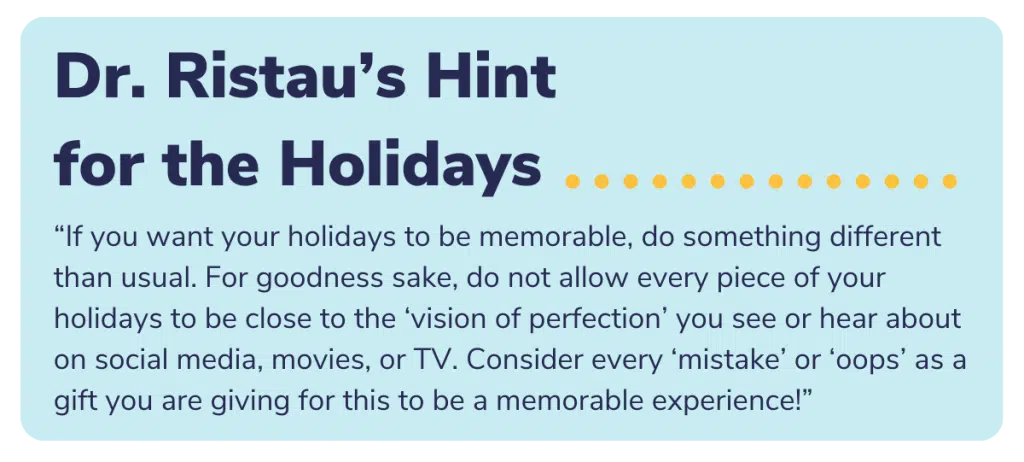
“I see it every year like clockwork, both professionally as well as within my personal life. Holiday months often bring us some of the most challenging parenting situations,” said Dr. Ristau.

Get Dr. Ristau’s top tips on managing parent stress during the holidays, plus the signs to watch for to ensure your loved one’s mental health is on the right path.
#1 Be real.
During the holidays, we often have a way of sugarcoating how life is going. But in reality, the best connections start with authenticity, says Dr. Ristau. As a parent or young adult, showing how you’re feeling and what you’re genuinely experiencing can go a long way in connecting with those around you.
“Each time you express your truth and are authentic with your trusted others, you open the door for someone else to feel inspired to do the same,” said Dr. Ristau. “Imagine the positive ripple you can start in removing the stigma of being human during a time of year that is both beautiful and horrible all at once!”
Most likely, if you’re feeling a certain way, those around you will be, too. It might sound scary, but the benefit outweighs the risk in most situations, says Dr. Ristau. Being authentic helps break down this perfect image of the holidays and the jolly tone that comes with it. Even though the holiday stress can be challenging, it never means you’re a failure.
“I promise you, imperfect parenting is the world’s greatest secret just waiting to be acknowledged,” said Dr. Ristau. “The gratification and validation instantly gifted to you and those around you, when you take the risk to be real, holds value beyond words.”
#2 Lower the bar.
Expectations are high during the holidays. We’re expected to find the time to attend parties and get-togethers, have enough money to get the right gifts, maneuver travel when there’s a foot of snow, and more. It’s essential to acknowledge and accept that you can’t do everything, and no, that doesn’t make you a bad parent.
As Dr. Ristau says, “You do not have to be the best, you do not have to give the most, you do not need to be responsible for finding the perfect, most amazing gift on the planet, and no, your kid’s life will not be ruined should you not get them that popular, highly coveted gift, toy, gadget, video game, etc.”
Instead, find ways to shift the attention from material items to valuable time together in the form of time spent together and serving others. “Know that when you do this, you may be building the foundation for your kids to truly appreciate material gifts for the meaning that gift-giving represents,” said Dr. Ristau. Just like gift-giving, thoroughly cleaning the house or perfecting a photo-ready dinner may not be the biggest priority all the time. If you’re feeling overwhelmed, minimizing these expectations for yourself is a true mental gift.
#3 Disconnect from your gadgets and reconnect with people in your life.
Technology is all around us, and during the holidays, we can undoubtedly fall into the habit of zombie scrolling daily—especially teens and young adults. But whether you’re watching the “big game” on TV or playing on a gaming console, you’re not truly connected with those around you. Take the time to disconnect from screens and get some IRL face time instead.
Adults and parents, make sure you’re reaching out to your loved ones often. Dr. Ristau says it doesn’t have to be an extensive conversation but rather a warm, caring moment to connect with and support them.
If you know someone who is currently struggling or has struggled with mental health challenges in the past, you can play a vital role in supporting them. The most important thing you can do is be present with them in the moment and engage them in a comfortable way.
“You don’t have to fix their problems or take away their pain. You can’t,” said Dr. Ristau. “But you can express understanding of their difficulty. You can express your hope for a better future. Life inevitably is nothing but change, and that means opportunity for better tomorrows.”
#4 Recharge with mini breaks.
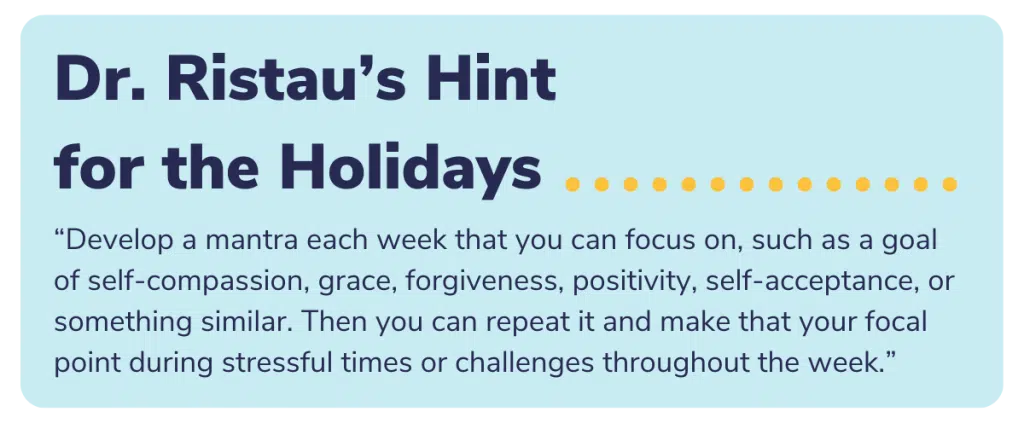
Pausing the chaos can go a long way, even if it’s just for a few minutes. Take a moment to breathe and notice things around you—it can recharge your mind, body, and soul.
Dr. Ristau suggests a few ideas for a mini break:
- Focus for a few minutes on something that gives you peace or a momentary feeling of happiness.
- Imagine a person in your life from past, present, or future who gives you a sense of love and appreciation.
- Repeat a phrase offering that person loving-kindness, then repeat the exact phrase offering yourself the same loving-kindness. Imagine those words move through your breath and down and around your heart, surrounding it like a big, comfortable, warm hug.
There are many relaxation techniques, and finding the one that works for you can be helpful when it seems like your life is out of your control. The whole family or people close to you can try things out and see what works. Whether you do these exercises together or at the same time in different spaces, they can help you all reconnect with a sense of peace. And that’s what the holidays can really be about.
Signs to Watch for During Holiday Break
With time off from school, your child or young adult can have their schedule disrupted, causing them to act differently. As you’re around them more during the holiday break, it’s essential to watch for signs that could indicate mental health issues.
Mental health warning signs include the following changes in behavior and physical symptoms.
- Sleeping very late in the morning
- Staying plugged in for hours at a time—watching television, playing video games, scrolling social media
- Showing lack of motivation or enthusiasm for friends and activities they used to enjoy
- Neglecting self-care, such as showers, exercise, etc.
- Being defensive when asked questions, resisting requests
- Acting agitated, sullen, or defiant
- Exhibiting extreme mood swings
- Exhaustion, fatigue
- Unexplained aches, pains, or stomach issues
- Changes in appetite or weight
If your child or young adult is demonstrating these behaviors, especially over an extended period or before the holiday break, seek support. Even if it’s the holiday season, you still need to reach out for help as soon as symptoms emerge. You’ll never regret being proactive, especially for a loved one. Learn five reasons parents delay treatment and why you should get help now rather than later.
You can connect to a no-cost screening anytime when you call our experts at 952-826-8475. Our team will guide you through the symptoms your loved one is experiencing and give you a plan no matter what.
Mental Health Doesn’t Take a Holiday—Connect to Care Today
The truth is that there’s no perfect time to embark on the healing journey. The best time to get started is always now. At PrairieCare, our team of experts draws on a system of care that focuses only on mental health, ensuring you or your child get specialty care to thrive. With several locations in the Twin Cities, Rochester, and Mankato, we can connect people of all ages to mental health treatment that fits their lives.
We offer various services, including inpatient hospitalization, residential treatment, and multiple outpatient programs. In addition, we have specialty tracks focused on disordered eating, perinatal care, and co-occurring substance use support. You don’t have to wait for the care you or your family need and deserve. Contact us today to get started.
Get a No-Cost Mental Health Screening Today
Anyone seeking services can call our team anytime at 952-826-8475 to access a no-cost mental health screening and ask any questions you may have about starting therapy. You can also request a screening using our form, and within one business day, our team will reach out to you to get started.
Not sure what a mental health screening includes? Click here to learn more about the benefits of calling PrairieCare for a screening.