


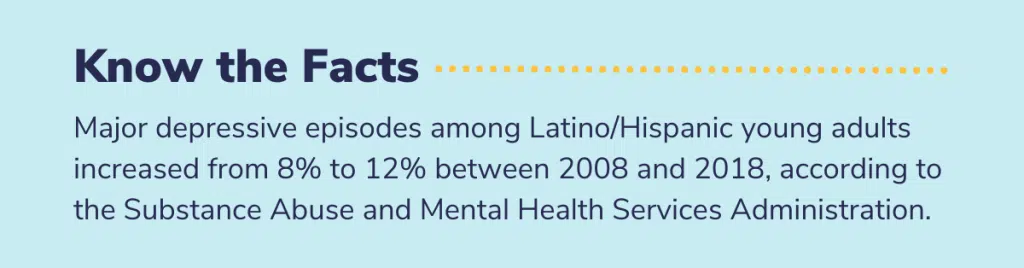
Research on the mental health of Hispanic and Latino young adults in the United States reveals that this group has been experiencing increased rates of mental health conditions in recent years. One survey found that just over half of Hispanic young adults report symptoms of depression and anxiety. Moreover, a new study shows that the pandemic had a significant negative impact on US-born young adults of Latino heritage.
Hispanic Heritage Month is an opportunity to increase awareness individually and societally around the challenges that this population experiences in the United States. This includes the traumatic stress of ongoing discrimination, bias, microaggressions, and outright violence. Moreover, Hispanic people encounter a variety of obstacles that can prevent them from accessing mental healthcare when they need it.
“As a woman with Spanish roots, I have always appreciated Hispanic Heritage Month because not only does it acknowledge Hispanic and Latin contributions to this nation, but it also highlights the different and unique qualities of different Hispanic and Latin cultures,” said Tiffany Young, a Psychiatric Mental Health Nurse Practitioner at PrairieCare.
“Growing up when I shared with others my Hispanic identity, I often received the response ‘Oh, so you’re Mexican?’ a not so uncommon response for many across the US. The unfortunate reality is, in many places across the US, there is a gross misunderstanding about what it means to be Hispanic or Latin,” said Tiffany. “It can be quite disheartening and degrading to constantly experience this misunderstanding when sharing your identity with others. Over time this can negatively impact one’s mental health.”
This article digs into recent research on the state of mental health as well as 5 ways people can access support.
Quick Links
- Why Are Latino Young Adults Experiencing High Rates of Mental Health Issues?
- What Prevents Hispanic/Latino Young Adults from Accessing Care?
- 5 Ways Latino Young Adults Can Access Mental Health Support
- Access a No-Cost Mental Health Screening
What Does Latinx Mean?
Latinx is a gender-neutral version of Latino (male) or Latina (female). All three terms are used to describe a diverse group of people who have roots in Latin America. Latin America encompasses South America, Central America, and some Caribbean islands. Yet, only 4% of US Hispanic people describe themselves as “Latinx,” and some even view it as a negative term.
“The term Latinx is controversial within Hispanic and Latin communities,” said Tiffany. “In my personal experience, I am not familiar with anyone that utilizes this term to describe their ethnic heritage. While well intentioned, it feels like a decision that was made for the community rather than with insight and feedback from the community.”
“Hispanic” is often used interchangeably with Latino/Latina/Latinx. However, the term Hispanic is typically used for people from Spanish-speaking countries (including Spain). Hence, a Brazilian-American would be considered Latino because Brazil is in Latin America. However, because Brazilians speak Portuguese, they would not be referred to as Hispanic. People with origins in Latin American countries where Spanish is spoken are Hispanic and Latino.
According to Mental Health America (MHA), Latino/Hispanic people in the United States come primarily from the following backgrounds:
- Mexican (62 percent)
- Puerto Rican (9.5 percent)
- Salvadorean (3.9 percent)
- Cuban (3.9 percent)
- Dominican (3.5 percent)
- Guatemalan (2.5 percent)
The Impact of the Pandemic on Hispanic Mental Health
Recent research looks at the effect of the pandemic on 300 Latino young adults living in the Salinas Valley in California. Published in the Journal of Adolescent Health, the study compared participants’ depressive systems before and after 2020. The researchers found that young adults’ depression significantly increased during the years following the start of the pandemic. This was particularly true for young women.
Caring for younger siblings, lack of self-care, economic strain, less physical activity, and household crowding all negatively impacted young Latina women’s mental health during this time. Notably, however, strong social relationships helped keep depression at bay for young women, and strong family relationships helped prevent an increase in anxiety.
Another study analyzed four years of mental health data (two pre-COVID and two after-COVID) in 1,200 Latino elementary and middle school students. The researchers found that Latino students are up to twice as likely to be at risk for depression and anxiety. Teen girls and nonbinary students had exceptionally high levels of mental health risk.
Consequently, if Latino/Hispanic teens don’t get the support they need, they may enter young adulthood with untreated mental health conditions. In addition to depression, these challenges can range from high-functioning anxiety to what’s known as “failure to launch.”
“There are multiple stressors that Latinx children and families have endured historically and in the past few years, in addition to the pandemic. These include hostile and discriminatory immigration policies and other forms of ethno-racial trauma. Measuring the direct and indirect impact of these events is challenging, and efforts are needed to isolate the combined effects of these stressors from those of the pandemic.” —2023 study, Journal of Clinical Child and Adolescent Psychology

Why Are Latino Young Adults Experiencing High Rates of Mental Health Issues?
It’s clear that the pandemic era disproportionately impacted Latino youth. However, as with their peers of other races and ethnicities, mental health issues have been increasing among Latino young adults in the United States since before the pandemic. In general, the young adult years are difficult to navigate. This is when young people attempt to forge their own independence and identity, find meaning and purpose in life, and create positive connections outside the family.
Why are Latino young adults struggling in particular? One reason is traumatic stress. Traumatic stress, particularly when experienced at an early age, leaves young people vulnerable to anxiety, depression, and other mental health conditions. Data shows that 78 percent of Latino youth suffer at least one adverse childhood experience (ACE), with 28 percent experiencing four or more ACEs. These traumatic stressors may be related to family circumstances (e.g., neglect, abuse, loss of a parent or guardian, poverty, or the stress related to immigration). Or they may be associated with the systemic racism that people of color experience in the United States.
Moreover, young adults, in general, of all races and ethnicities, have been experiencing higher rates of mental health conditions over the last decade. Experts attribute this to a variety of factors, including the negative effects of social media, increased loneliness among young adults, and anxiety about the environment and political issues.
Mental Health in Latino/Hispanic LGBTQ Youth
Latino/Hispanic teens and young adults who identify as LGBTQ experience additional stress and discrimination, leading to increased mental health challenges. The Trevor Project 2024 survey tracked data on this group. Here are some of the findings for the past year:
- 40 percent of Latinx/Hispanic LGBTQ young adults considered suicide, and 13 percent attempted suicide
- 65 percent of this group report anxiety, and 56 percent report depression
- 62 percent feel discriminated against due to their gender identity
- 44 percent feel discriminated against due to their sexual orientation
- 13 percent of Hispanic/Latinx teens and young adults have been physically threatened or harmed in the past year due to their sexual orientation.
- 24 percent have experienced physical threats or harm due to their gender identity.
What Prevents Hispanic/Latino Young Adults from Accessing Care?
US young adults have the highest rates of mental health conditions of any age demographic. However, many are unable to access mental health services or don’t seek care. This is true of Latino/Hispanic young adults as well.
Research using data from the national Household Pulse Survey found that Hispanic and Black young adults were the most likely to report mental health symptoms. About half of Hispanic/Latino young adults (51 percent) reported experiencing symptoms of anxiety and/or depression. And about half of those reported that they needed mental health services but did not receive any. By contrast, among white young adults, about a third needed mental healthcare but did not receive it.
In addition, SAMHSA data shows that about 90 percent of Latino/Hispanic people over the age of 12 with a substance use disorder did not receive treatment.

Obstacles to Mental Healthcare for Latino Young Adults
One of the biggest obstacles that prevent Latino/Hispanic young adults from accessing care is the lack of culturally competent mental health professionals. Culturally competent care refers to being mindful and aware of a client’s cultural values, beliefs, and differences when providing mental health treatment. Many people of color would prefer to work with a mental health professional who understands their cultural experience.
However, according to American Psychological Association data, only 8 percent of US psychologists are Hispanic. This can lead not only to a lack of understanding but also to misinterpretation or misdiagnosis. For example, depression in Latino/Hispanic young adults tends to show up as physical symptoms, such as fatigue or headaches. However, not all mental health professionals could recognize these physical issues as mental health indicators.
There’s a reason why mental health issues in this group often manifest in physical rather than emotional symptoms. Latino/Hispanic young adults may unconsciously suppress feelings of sadness, anxiety, grief, or fear due to cultural values in their family or community. Some Hispanic/Latino families and communities see mental health problems as inappropriate or shameful to talk about publicly. This stigma can prevent young adults from acknowledging and discussing their feelings. They may not even admit to themselves what they’re going through.
Moreover, many Latino/Hispanic young adults are raised with an expectation of self-reliance—that they should be able to take care of themselves without additional support. In analyzing mental health screenings taken on their website, Mental Health America found that significant percentages of Latino/Hispanic respondents said they would self-monitor their mental health or ask for guidance from a peer rather than seeking mental health services.
The “model minority” syndrome contributes to this outlook. This is the idea that people from a particular ethnic background need to be extra hardworking and successful to disprove racist stereotypes. This myth puts pressure on younger generations to hide their emotional struggles as they attempt to live up to an imagined ideal.
The cost of mental healthcare is also a factor for Latino young adults and families. According to the US Census Bureau, 18 percent of Hispanic/Latino people do not have insurance. And fewer than half of Hispanic children living with their parents are covered by private health insurance.

5 Ways Latino Young Adults Can Access Mental Health Support
Here are some ways Latino/Hispanic young adults can get help and support for mental health issues as quickly as possible.
Contact PrairieCare
Our experts are available anytime at 952-826-8475 to help you or a loved one toward a path to a mentally healthy life. We offer no-cost mental health screenings by phone or by making a request here. PrairieCare is dedicated to helping people of all ages access our full continuum of care across Minnesota to help them heal and thrive.
Take Mental Health America’s free online screening
After taking the screening here, you will receive information, resources, and tools to help you understand and improve your mental health. Self-care can be a powerful tool for increasing well-being. However, most mental health conditions don’t get better without treatment. Hence, lifestyle changes are important, but accessing professional care is essential.
Contact your insurance company
If you have private insurance, an agent can tell you your mental healthcare coverage and what treatment facilities the company works with. Medicaid and other public insurance plans will also inform you about mental healthcare coverage and providers in the plan.
Talk to your primary care provider
A doctor or physician’s assistant can provide a referral and a list of mental health providers in your area. Keep going down the list until you find a program or therapist who will take new clients and preferably accept your insurance. If they’re not taking new clients, ask them if they’ll help you find someone who does or if they are willing to do an assessment to help you determine the right level of care.
Call a hotline
If you need immediate help, you can reach the Suicide and Crisis Lifeline by calling or texting 988 or using the chat box at 988lifeline.org/chat. You can also call 911 or go to the emergency room of your local hospital. For LGBTQ young people, The Trevor Project offers free and confidential phone and text hotlines.
Specialized Mental Health Treatment at PrairieCare
If you or a loved one need support with mental health, PrairieCare can help. Our inpatient hospital, residential treatment, and outpatient programs provide safe and supportive environments with specialized treatment plans for people at any point in their mental health journey. With evidence-based care and various locations throughout Minnesota, you don’t have to wait to get the mental health support you deserve.
Our culturally competent and evidence-based care guides patients in building self-worth, forming authentic connections with others, developing a sense of purpose, practicing self-care, and cultivating hope. Our multidisciplinary teams are trained to guide people of all ages to navigate the internal and external challenges they face at any stage of life. Contact us today to learn more and get started on the path to healing.
Sources
- J Adolesc Health. 2023 Jul; 73(1): 201–204.
- J Clinical Child Adol Psychol. 2023 Mar: 52 (3): 10.1080.
- J Adolesc Health. 2022 Jun; 70(6): 985–988.
- Mental Health / July 5, 2023